
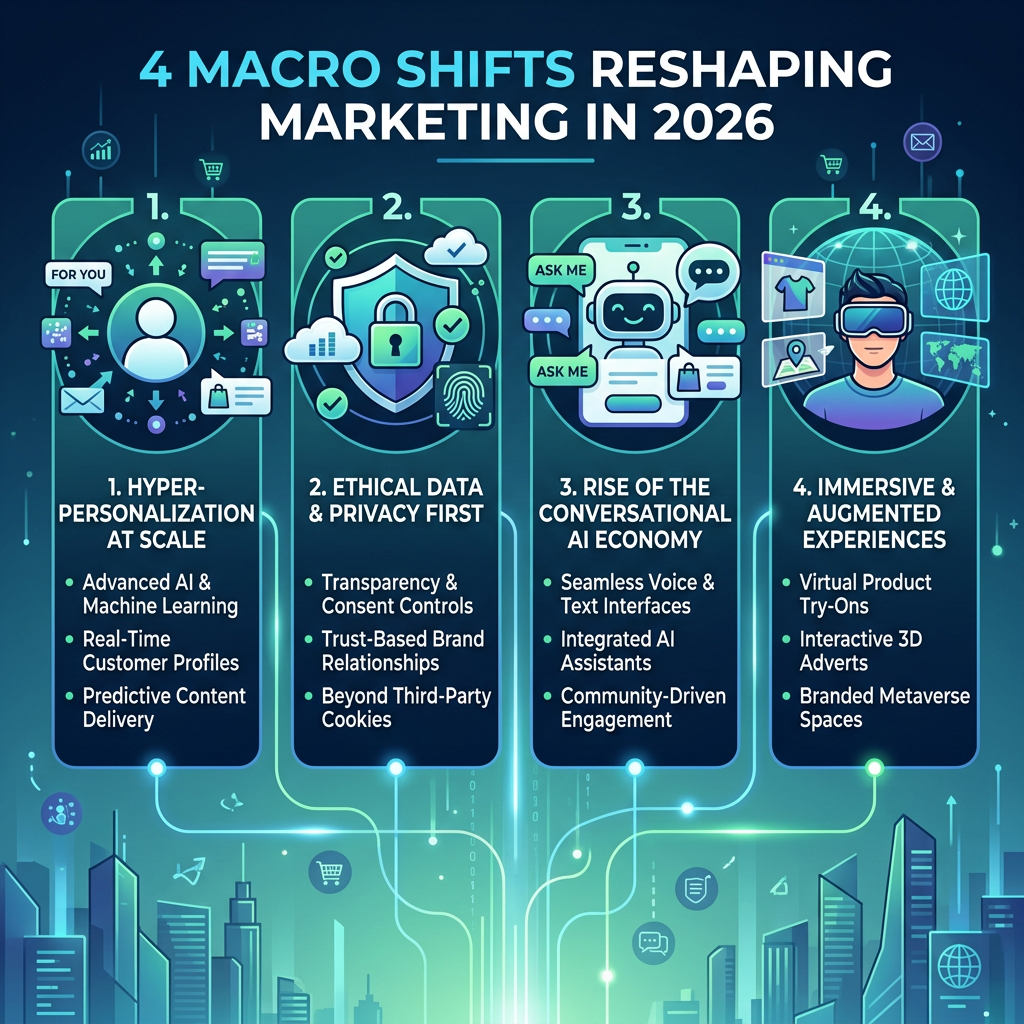
Marketing leaders today face a defining inflection point. Topline budgets have plateaued at an average of 7.8% of company revenue, while legacy demand generation engines—built around gated eBooks, single-contact MQLs, and keyword-stuffed SEO—are yielding diminishing returns.
According to Gartner, over 56% of CMOs report their existing budgets cannot achieve growth targets using traditional playbooks. Yet, the highest-performing revenue teams aren’t simply cutting costs; they are rearchitecting their go-to-market (GTM) engines around four foundational macro trends.
1. The Death of the Solo MQL: Moving to Buying Group Orchestration
The myth of the single B2B decision-maker filling out a form is officially broken. Forrester’s latest benchmark reveals that enterprise purchases now involve an average of 13 internal stakeholders and 9 external influencers. Crucially, 78% of the buyer’s journey takes place before they ever talk to sales.
Modern buyers conduct self-directed research across dark social channels, peer networks, and ungated technical resources. Winning teams are replacing individual lead scores with signal-based orchestration—monitoring account-level engagement surges, multi-threading across buying committees, and capturing high-intent signals early.
2. The Agentic AI Era: From Assistive Copilots to Autonomous Systems
While 94% of marketing teams now leverage AI in content workflows, the frontier has moved beyond prompt-driven drafting. The shift from assistive AI to Agentic AI enables autonomous systems to handle multi-step operational tasks independently.
Autonomous agents now monitor buyer intent, enrich CRM records in real time, trigger hyper-personalized outreach, and dynamically reallocate programmatic ad spend. For marketing operations (MOps), the mandate is evolving into AgentOps: establishing governance, maintaining data hygiene, and designing human-in-the-loop escalation paths.
Key Benchmark Snapshot:
- 7.8%: Average marketing budget as a percentage of company revenue (Gartner).
- 13: Average internal stakeholders involved in enterprise B2B purchasing decisions (Forrester).
- 60%–65%: B2B search queries that result in zero clicks due to AI Overviews (Digital Applied).
- 31%: Average reduction in fragmented MarTech point tools as teams consolidate (MarTech Audit).
3. The Zero-Click Search Landscape and Generative Engine Optimization (GEO)
Search behaviour has fundamentally transformed. With conversational answer engines and AI Overviews, 60% to 65% of informational search queries now end in zero clicks. Keyword rankings alone no longer guarantee website traffic.
To stay visible, forward-thinking brands are prioritizing Generative Engine Optimization (GEO). The objective is to build high-authority domain presence, publish proprietary research reports, and structure authoritative data so AI engines reference and cite your brand as an authoritative source.
4. MarTech Consolidation & First-Party Data Architecture
After years of unchecked software bloat, revenue leaders are actively reducing their MarTech footprints by up to 31%, eliminating redundant tools in favor of unified customer data platforms (CDPs) and clean data warehouses.
Coupled with stricter global privacy regulations and cookie deprecation, attribution is shifting toward a hybrid model: robust first-party server-side tracking combined with Marketing Mix Modeling (MMM) and customer self-reported attribution.
Strategic Takeaways for Revenue Leaders
- Shift from Lead Quantity to Pipeline Velocity: Align marketing KPIs with account consensus, committee engagement depth, and deal acceleration.
- Invest in Defensible Thought Leadership: When generic content is commoditized by AI, proprietary benchmarks, client case studies, and original points of view become your primary competitive moat.
- Unify the Core Data Layer: Ensure your CRM and data pipelines are clean and structured before deploying autonomous agents at scale.
Ready to Modernize Your Marketing Engine?
At Ourea Marketing, we help high-growth brands architect signal-based demand systems, deploy agentic workflows, and build high-authority GTM strategies. Contact our team today to explore how we can elevate your marketing pipeline.
Leave a Reply