
Marketing and Go-To-Market (GTM) leaders are navigating an uncompromising, efficiency-driven economic climate. According to Gartner’s latest CMO Spend Survey, marketing budgets have flatlined at just 7.7% of total company revenue (down from historic 9.1%+ averages), with 59% of CMOs reporting that their current resources are insufficient to hit aggressive growth targets.
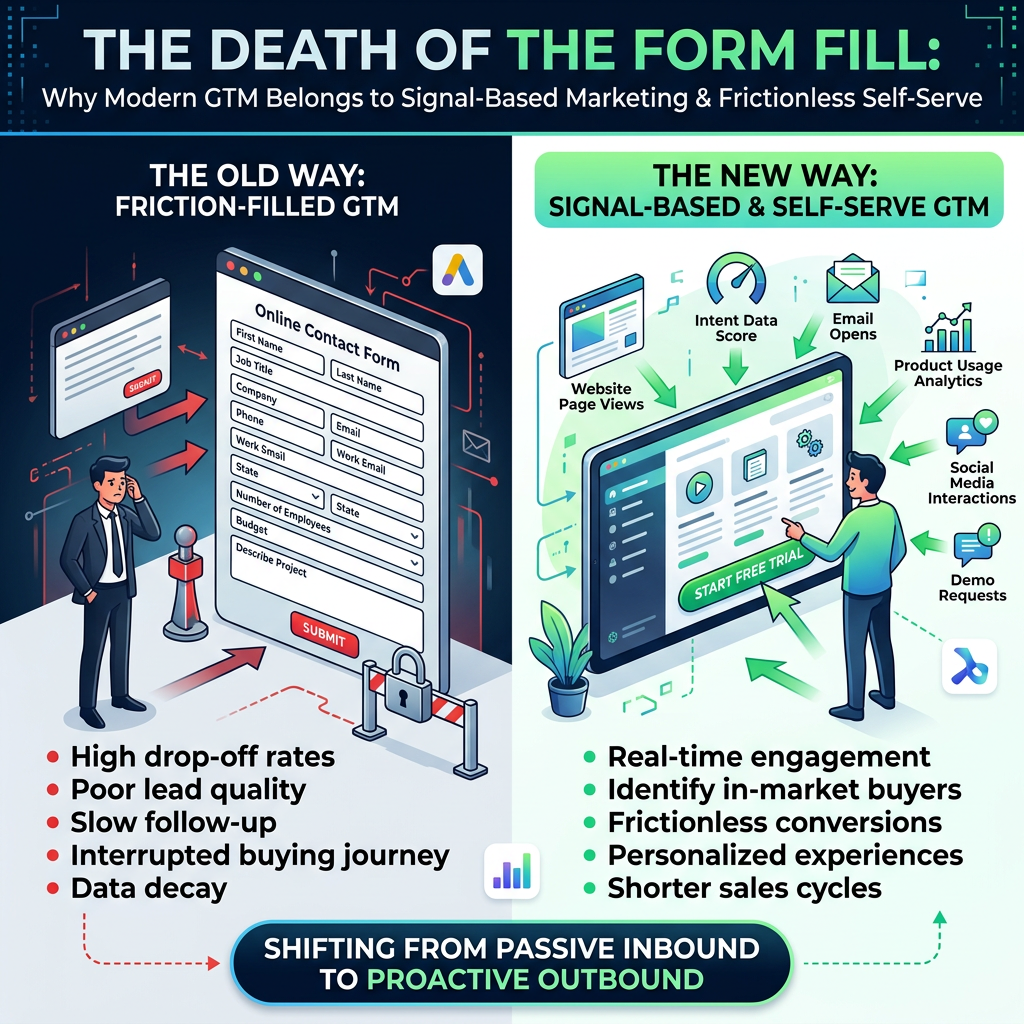
Compounding this budget crunch is a fundamental revolution in buyer behavior. Today’s decision-makers—increasingly Millennial and Gen Z professionals—reject traditional sales friction, 7-field gated forms, and aggressive cold cadences. In fact, research indicates that 70% to 80% of the B2B buyer journey is completed anonymously across peer communities, AI search engines, and review sites before a prospect ever reaches out to a sales rep.
To win in this environment, high-performing revenue teams are dismantling yesterday’s playbooks and embracing three foundational shifts in Demand Generation and Marketing Operations (MOps).
1. Moving from Static Inbound to Signal-Based Account Intelligence
The legacy playbook of locking an eBook behind a form, generating a low-intent “MQL,” and passing it immediately to an SDR for automated cadences is burning pipeline and brand equity. In response, modern demand gen teams are replacing static forms with Signal-Based GTM.
Rather than waiting for a form submission, teams monitor a composite of high-intent buying signals:
- First-party product & pricing engagement: Multiple stakeholders from target accounts revisiting technical documentation or pricing pages.
- Ecosystem shifts: Job changes, executive hiring patterns, or installations of complementary tech stack software.
- Integrated ABM coordination: Aligning demand generation and Account-Based Marketing—a motion now fully integrated by 47% of B2B marketing leaders.
2. The $1M+ Self-Serve Milestone
Perhaps the most startling transformation is the democratization of enterprise purchasing. Forrester Research projects that over 50% of B2B transactions exceeding $1,000,000 will be processed through digital self-serve channels, vendor marketplaces, and transparent digital portals.
B2B buyers no longer accept a 30-minute discovery call just to see a product demo or understand baseline pricing. Forward-thinking companies are turning their digital footprints into interactive product experiences—incorporating self-guided product tours, interactive ROI calculators, and friction-free conversion workflows.
3. Agentic Marketing Workflows vs. Commoditized AI Spam
While artificial intelligence has lowered the cost of content production, it has also created a sea of inbox noise. Inboxes are flooded with generic, automated sales sequences that degrade buyer trust.
Winning MOps organizations are moving toward agentic workflows—using AI agents not to mass-blast outreach, but to enrich real-time account data, synthesize multi-channel buyer signals, and arm human sales teams with actionable context. Speed is handled by AI; nuance, strategy, and domain authority remain firmly human.
4. The Rise of Generative Engine Optimization (GEO) and Thought Leadership
As buyers turn to conversational LLM search interfaces (Perplexity, ChatGPT, and Google AI Overviews) for their initial vendor discovery, search marketing is expanding into Generative Engine Optimization (GEO). Meanwhile, Content Marketing Institute reports that 58% of B2B marketers feel their current content strategies are only moderately effective.
To stand out, brands are doubling down on practitioner-led perspectives, proprietary industry research, and executive thought leadership that LLMs can cite and buyers can genuinely trust.
Key Takeaways for Marketing Leaders
- Update your best insights:” Meet buyers in the “dark funnel” where 80% of decision-making takes place.”
-
Build a signal engine:” Shift SDR and demand teams from static cold outbound to real-time intent triggers.”
- Enable frictionless evaluation:” Deliver transparent pricing, interactive demos, and streamlined digital evaluation paths.”
Leave a Reply