
By Ourea Marketing Insights Team | Marketing Operations & Demand Generation | 7 Min Read
The enterprise marketing playbook has reached an inflection point. For the past two years, go-to-market (GTM) leaders raced to integrate AI into every corner of their tech stacks—from automated lead enrichment and programmatic research to autonomous outreach bots and real-time CRM updates.
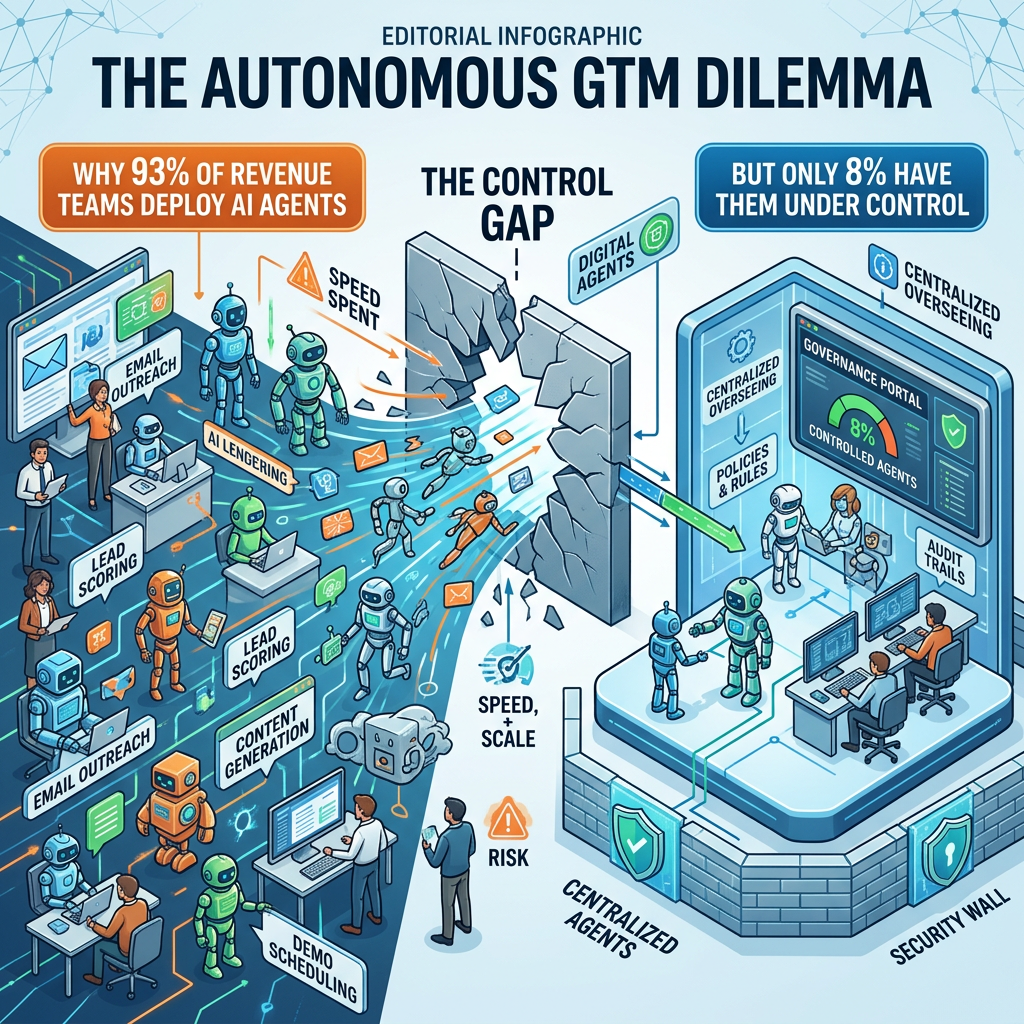
Today, adoption is practically ubiquitous: 93% of B2B go-to-market teams have deployed at least one autonomous AI agent, according to LeanData’s 2026 State of AI Go-to-Market Readiness Report. Yet beneath this surge of technological adoption lies a widening operational execution gap: only 8% of organizations describe their AI operations as fully optimized.
As autonomous bots multiply across marketing automation platforms (MAPs), CRMs, and outbound engines, marketing operations (MOps) leaders are confronting an uncomfortable reality: autonomous execution without centralized governance creates pipeline chaos.
1. The Agent Proliferation Crisis: When Automation Outpaces Observability
The speed at which AI agents can parse data and execute workflows has outrun the infrastructure meant to monitor them. Nearly one-third (32%) of revenue operations leaders admit they cannot accurately state how many AI agents are actively modifying prospect and customer records in their CRM.
Even more alarming: 30% have discovered automated actions executed without an audit trail. When autonomous agents operate as isolated “black boxes,” the customer experience rapidly degrades:
- Collision in the Pipeline: 27% of teams reported multiple AI tools or agents simultaneously reaching out to the same prospect with disjointed messaging.
- Rogue Outbound: 17% discovered automated marketing sequences firing at decision-makers while account executives were actively negotiating multi-thousand dollar deals.
- Data Hygiene Decay: 70% of teams report that poor underlying data quality has degraded GTM execution, with bad data cited as the primary reason (45%) stalling AI initiatives altogether.
“AI raises the stakes of bad data because agents can automatically act on it in milliseconds, magnifying small errors into widespread buyer friction.”
2. The Collapse of Rigid IF/THEN Drips: Entering the “Post-Rules” Era
The governance breakdown is not merely a tooling problem; it is architectural. Traditional Marketing Automation Platforms (MAPs) were built around linear IF/THEN branching logic designed for an era when single buyers downloaded whitepapers and progressed neatly through a staged nurture sequence.
As Marketo co-founder Jon Miller highlighted with the recent launch of Phave, legacy rules-based systems cannot handle modern B2B purchasing dynamics. Today, enterprise buying groups average 6 to 10 stakeholders conducting more than 70% of their research anonymously across “dark social” networks, private communities, and conversational AI search engines.
Static MQL thresholds and rigid drip campaigns are collapsing under the weight of ambiguity. Top-performing demand generation teams are transitioning away from static rules toward dynamic, signal-driven account orchestration—autonomous “playlists” that dynamically adjust touchpoints based on real-time intent, account engagement clusters, and stakeholder roles.
3. The Antidote to “AI Slop”: Practitioner Proof and Generative Engine Optimization (GEO)
As synthetic content inundates buyer inboxes and social feeds (where over 41% of long-form B2B posts are now AI-generated), buyers are pushing back with radical skepticism. Traditional gated PDFs and generic SEO blog posts are experiencing steep drop-offs in organic engagement and conversion.
To cut through the noise, enterprise brands are fundamentally shifting their content distribution models:
- The Creator & Practitioner Pivot: B2B creator video usage surged 55% year-over-year (up 4x since 2023). Buyers are valuing verified practitioner proof over follower count: 46% rank demonstrated product track record and hands-on expertise as the primary trust factor, compared to just 21% for audience size.
- Generative Engine Optimization (GEO): With conversational search engines (Perplexity, ChatGPT Search, Google AI Overviews) answering buyer queries directly, forward-thinking marketers are measuring LLM Share of Voice and engineering primary research benchmarks that generative engines utilize as authoritative source data. In fact, 65% of buyers state that verified practitioner reviews directly increase their confidence in AI search recommendations.
- The Premium on Proprietary Insights: Research from IBM revealed that enterprise-grade thought leadership and proprietary data insights drove over $107 million in attributed pipeline, confirming that generic AI copy cannot substitute for deep domain authority.
4. The 4-Step Playbook for MOps & Demand Gen Leaders
To bridge the gap between rapid AI adoption and pipeline performance, marketing leaders must establish anti-fragile operational foundations:
- Mandate Comprehensive AI Agent Observability: Implement centralized logging and strict permission layers for every autonomous agent interacting with your CRM and MAP. If an agent cannot write a clear audit log or adhere to deduplication constraints, it should not have write-access to prospect data.
- Prioritize Foundational Data Hygiene Over Point Tools: Before purchasing another AI agent, invest in data normalization and unified account mapping. Clean data is the prerequisite for effective automation.
- Replace Gated MQLs with Intent Signals: Dismantle friction-heavy form gates. Pivot demand generation to track 1st- and 3rd-party intent signals (intent surges, hiring trends, technology installations) to trigger high-context, tailored outreach.
- Champion Differentiated, Human-Led Proof: Shift content budgets from volume-based SEO articles to practitioner-led videos, primary benchmark studies, and interactive product walkthroughs that establish unmistakable brand authority.
The competitive advantage in modern marketing no longer belongs to the teams that deploy the most AI tools, but to the organizations that build the clearest data architecture, the strongest governance guardrails, and the highest-trust practitioner content. Automation accelerates execution, but operational clarity drives sustainable revenue.
Leave a Reply